
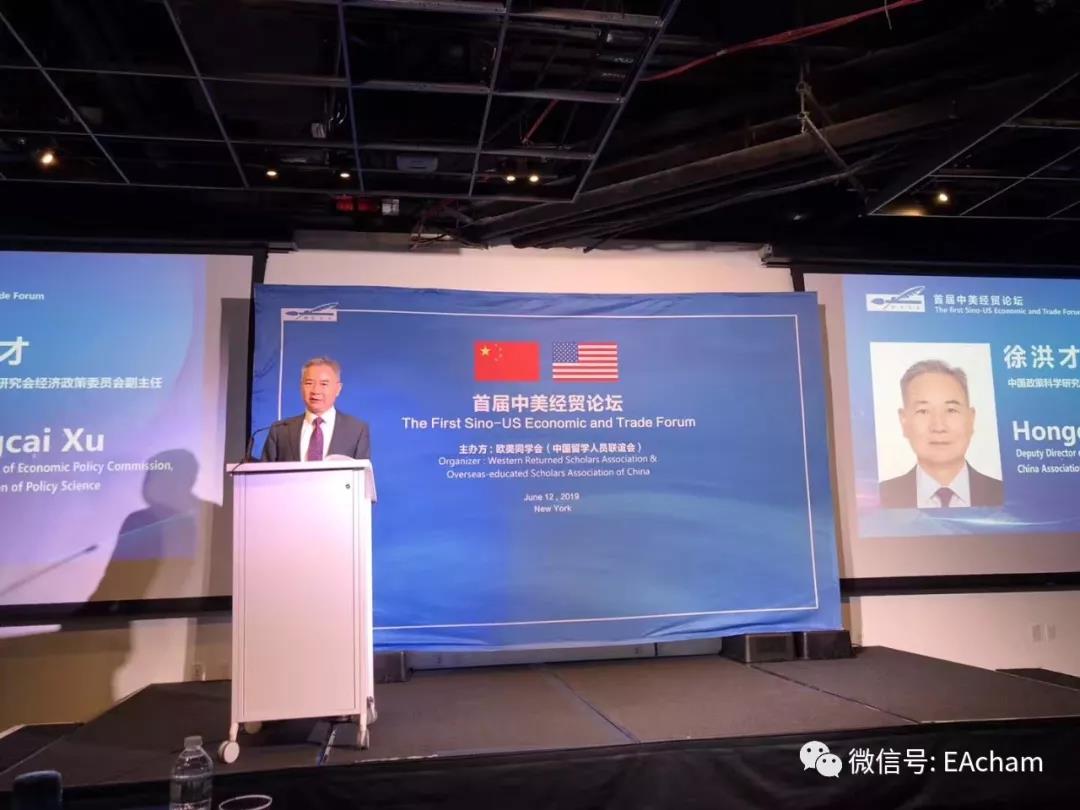
Relaunching rational dialogue to tackle China-US trade conflict
Hongcai XU, Ph.D., Professor
Deputy Director of Economic Policy Commission under China Association of Policy Science On June 12th , 2019, at 237 Park Ave New York
Ladies and gentlemen, good morning!
I am a think-tank scholar from Beijing for economic policy research. In the past ten years, I have devoted myself to promote China-US economic cooperation. Today, it’s my privilege of making a presentation in New York, this international metropolis. My topic is relaunching rational dialogue to tackle China-US trade conflict. As we all know, it is not easy to talk about this issue under the current complicated context of China-US relation. At present, China-US trade conflicts have spread to the fields of science and technology, culture, and many other areas. Some even dangerously elevate them to the level of clash of civilizations and the new cold war, creating a horrible atmosphere.
Last November, I published an article entitled At a Crossroads: Global leaders need to work together to meet Challenges in the British magazine Economist. After that, to my delight, some heavyweight political figures such as the former treasury secretary of the US Henry Paulson repeated my view. In February, I addressed a speech named China-US relations and China’s role in the sustainable development of the world economy in the London School of Economics and Political Science. I awaken again the public that China and the United States need to strengthen their strategic cooperation but not confrontation.
In the last two years, there has been mounting populism, protectionism, and unilateralism, while economic globalization has been hampered and the multilateral trade system threatened. In fact, the imposition of tariffs by the US on China’s exports has led to a more massive trade imbalance. Anyone who has taken introductory economics in college knows that a trade tariff is simply a transfer to government from the consumers and producers. As a result, some farmers and residents in the US actually have to pay for tf the US, the China-US trade deficit widened to about $420 billion in 2018 from about $370 billion in 2017. It was clear that the therapy imposed by tariffs would not work. The US tariff measures lead to a decrease in the volume of China’s exports to the US, and the US exports to China have dropped. China’s investment in the US continues to fall, and the growth rate of US investment in China has also slowed down. At the same time, the trade conflict has a negative impact he price of the trade conflict. According to the Commerce Department oon investors’ confidence. Global investors have suffered huge losses.
Therefore, the downward pressure on the world economy has increased significantly. One week ago, on June 4, the World Bank released the report on 2019 Global Economic Prospects: Heightened Tensions, Subdued Investment. The report said that the global economic momentum is fragile and subject to substantial risks. International trade and investment have been weaker than expected at the start of this year. Recently, International Monetary Fund chief Christine Lagarde said “the tensions between the United States and China are a threat for the world economy.” Billionaire investor Warren Buffett also expressed his disappointment at the trade war. Undoubtedly, the most tremendous risk to the world economy is the escalating trade conflict between China and the US. The actions of the US disrupted global value chains and supply chains, which would lead to Asian areas and the EU adversely affected by contracting trade. Even US suppliers could not be immune to the ripple effect.
We must know that China is the world’s biggest developing country, and the US is the biggest developed country. Trade and economic relations between both sides are of importance for them and for the stability of the global economy.Since China's entry into WTO, China and the US have built up a mutually beneficial relationship of structural synergy and interests convergence based on their comparative advantage and market choice. The close cooperation and economic complementation between them have increased the employment, and optimized the economic structure between the two countries, and at the same time enhanced the efficiency of global industrial divide.
Furthermore, China and the US are at different stages of development. Two countries have different cultural tradition and economic systems. Some level of trade friction is natural. In the spirit of equality and rationality, the two countries have set up several communication and coordination mechanisms such as the Joint Commission on Commerce and Trade, the Strategic and Economic Dialogue, and the Comprehensive Economic Dialogue. Each has made tremendous efforts to tackle all kinds of challenge and move economic and trade relations forward. China-US economic and trade cooperation is the anchor and propeller of our bilateral relations.
However, unfortunately, some people don't understand why they can't let the trade war escalate. The lessons of history should not be forgotten. In 1930, President Hoover signed the trade protectionism bill, the Smoot-Hawley TariffAct, in response to the economic crisis in the US, imposing high tariffs on more than 20,000 imports, with the highest tariff rate approaching 60%. After that, trade partners have taken retaliatory tariff measures to trigger a brutal global trade war. In the period from 1929 to 1933, the import of the US was reduced by 66%, the export was also declined by 61%, and the global trade scale was reduced by 67%. The historic tragedies should not be repeated. In my view, currently, both China and the US urgently need to calm down, returning to the track of negotiations, and gradually resolving the trade imbalance through strengthening structural reform and expanding opening up.
The experience has shown that cooperation serves the interests of the two countries. The conflict can only hurt both. Based on the present situation, I honestly make the following three proposals:
First, the US should not regard China as a strategic competitor, but as an equal partner. It seems very difficult to do so. I suggest that you read carefully the speech delivered recently by Singapore Prime Minister Lee Hsien Loong. He feared that increasing tensions between China and the US could negatively impact on world peace and prosperity. At the same time, he earnestly pointed out that it will be impossible for the US to contain China's rise, and that China will eventually become a responsible and merciful power. Therefore, the US should make adaptive adjustments, enhance strategic mutual trust, resolve ideological differences, and strengthen cooperation in all fields.
Second, strengthen trade, investment, and financial cooperation between the two countries. The pragmatic solution to China-US trade imbalance is to expand the US exports of high technology and services to China, not to reduce China’sexports to the US. China is opening up its markets, promoting the negative list systems for market access and implementing a competitive neutral policy. The US should actively participate in this opportunity to share China's development dividends. At the same time, to expand bilateral investment cooperation, Chinese enterprises have international first-class building capacity in bridge, expressway,and railway construction, which can help the US improve infrastructure. China and the US can strengthen the investment in traditional cleaning Energy, new energy, energy conservation and power grid construction and operation and pollution control, as well as jointly in dealing with climate change and strengthening investment in agriculture, including rural transportation, water conservancy, agricultural varieties, mechanization, modern logistics system and so on. Financial services are the strength of the United States. Not long ago, China announced 12 policies to expand financial opening, and the US should not miss this opportunity.
Third, strengthen people-to-people exchanges between both countries. In passed years, the vigorous development of China-US cultural exchanges has effectively promoted their economic and political cooperation and enhanced the basis of public opinion for the friendship. It is essential to promote China-US relations, in the long run, to maintain and deepen exchanges among educational and cultural institutions. However, recently, the US federal government has imposed visa restrictions on Chinese students studying in the US, extended the visa examination cycle, and shortened the validity period. The US also canceled a group of Chinese scholars to the US for ten years. This kind of behavior shocked me. I think it is necessary to sow the seeds of friendship among young people to enhance mutual understanding between both sides.
Ladies and gentlemen,
Looking into the future, China will continue to focus on the supply side structural reform and expand opening-up. It is expected that China’s economic
growth rate in 2019 will remain at about 6.3%. The domestic demand will make more contributions to economic growth. The economic structure tends to be optimized. Moreover, China will continue to promote international cooperation along the belt and road based on the principle of “consultation, contribution, and shared benefits”, promote the facilitation and liberalization of trade and investment, promote the fairness of rules, promote the reform of global economic governance with the WTO at the core, and build a community of shared future for humankind.
I believe that the economic globalization is the trend of the times and China's peaceful rise is also inevitable. Peace and development represent the shared aspiration of all peoples. China-US economic and trade ties concern not only the well-being of the peoples of the two countries but also world peace, prosperity, and stability. Cooperation is the only correct option for China and the US, and only a win-win approach will lead to a better future.
Therefore, I call again for relaunching rational dialogue between the two countries as soon as possible to avoid getting into bigger trouble.
Thank you so much.
E-mail:gz@eacham.org
Shanghai Office:
Global Chambers Zone
No.624C of Office Building B, National Convention and Exhibition Center(Shanghai)
Tel:+86-13917039347
E-mail:shanghai@eacham.org
Room 607, No,1 East International Building, No,1 Ciyunsi, Chaoyang District, Beijing.
E-mail:info@eacham.org
Admin@eacham.org

